

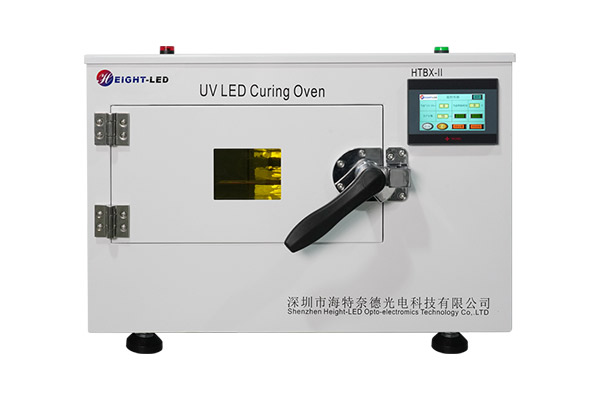
Model:HTBX-II-SB300300-NH
Equipment Features
1. The equipment features curing functions in both Nitrogen Mode and Non-Nitrogen Mode.
2. Non-Nitrogen Mode: Offers optional automatic or manual operation:
In automatic mode, the UVLED switch is controlled by access control induction.
In manual mode, the UVLED switch is controlled via the touchscreen.
3. Nitrogen Mode: After closing the door, click the start button to begin nitrogen charging. When the charging time and internal cavity pressure reach the set values, the UVLED starts irradiating and timing. Once the irradiation time elapses, the UVLED automatically turns off, and the exhaust valve opens. The safety door can only be opened after exhaust is complete.
4. The equipment supports a nitrogen charging interface, with adjustable nitrogen charging time and pressure. It also enables real-time cavity pressure detection and overpressure protection.
5. The equipment is equipped with functions such as production counting and historical data query.
Excimer Light Source Features
1. 172 nm operation does not require a vacuum or special gas environment; it can be directly used in normal pressure air or inert gas environments, greatly simplifying equipment and usage procedures.
2. 172 nm high-energy photons can directly break or excite chemical bonds in molecules, initiating photochemical reactions. This allows direct surface treatment of materials without relying on photoinitiators.
3. Energy is highly concentrated in a very small area near the light source, enabling highly localized surface modification or cleaning with minimal impact on adjacent areas.
4. In an air environment, these free radicals rapidly react with oxygen, ozone, or water to introduce oxygen-containing functional groups (such as -OH, C=O, COOH) on the material surface, significantly improving surface hydrophilicity, wettability, and adhesion.
5. 172 nm treatment is primarily a photochemical process, generating minimal heat. This makes it ideal for processing heat-sensitive materials (such as certain plastics, films, and biological materials) without causing thermal damage or deformation.
6. The light source does not directly contact the object being processed; it acts via radiation, avoiding contamination or damage that may result from physical contact.

